

Saner Container Orchestration Node Protection (CONP)
Protect the Nodes Powering Your Kubernetes Clusters
Saner CONP protects the operating systems beneath your Kubernetes clusters with continuous node visibility, exposure monitoring, vulnerability management, patching, hardening, compliance, and runtime controls.

How it works
Powered by Prevention
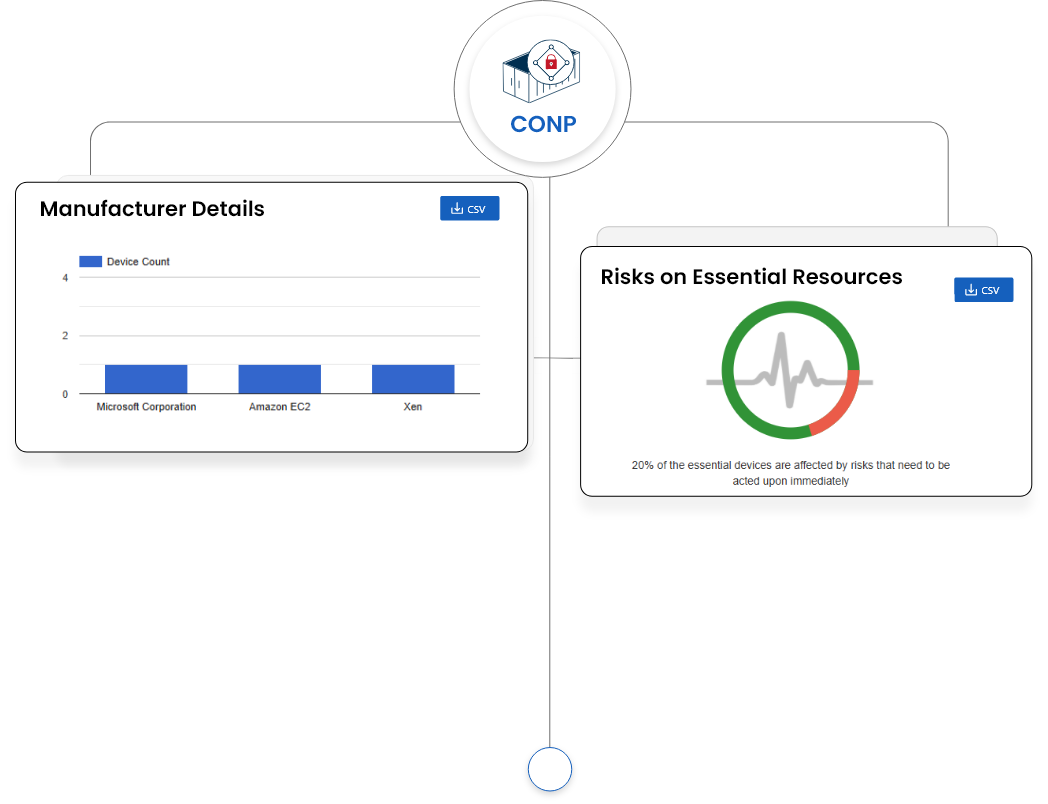
Saner COSP discovers the nodes powering your Kubernetes clusters and uses its existing DaemonSet reach to deploy the Saner CONP. Once deployed, CONP applies SecPod’s prevention-first approach directly to the node. It continuously monitors vulnerabilities, patch state, configuration posture, exposed services, compliance, and runtime controls, while giving teams a path to remediate identified risks.
How it works
Powered by Prevention
Saner COSP discovers the nodes powering your Kubernetes clusters and uses its existing DaemonSet reach to deploy the Saner CONP. Once deployed, CONP applies SecPod’s prevention-first approach directly to the node. It continuously monitors vulnerabilities, patch state, configuration posture, exposed services, compliance, and runtime controls, while giving teams a path to remediate identified risks.
Your first 30 days with Saner
From deployment to measurable risk reduction — here is what to expect.

Complete Node Visibility
COSP discovers eligible nodes across your Kubernetes environments and brings them into CONP protection. Teams gain visibility into node operating systems, applications, packages, services, vulnerabilities, exposure, and configuration posture, giving them a clear starting point for node security.
Critical Node Risk Prioritized
Exposure context, vulnerability severity, patch state, configuration posture, and watchlists help teams identify the nodes that require earlier attention. Instead of treating every node and finding equally, teams can focus remediation efforts where they can reduce the most risk.
Continuous Node Protection in Place
Continuous monitoring keeps configuration drift, posture anomalies, patch state, compliance, and exposure changes visible as Kubernetes environments evolve.
Key Features
Everything you need to stay ahead of threats.
Inventory and Asset Exposure
Track node changes that can quietly increase security risk.
Saner CONP continuously monitors nodes for configuration drift, posture changes, new exposure paths, and anomalous activity. Watchlists keep important nodes in focus, while anomaly confidence and whitelisting help teams distinguish meaningful security changes from expected deviations.
Continuous Monitoring and Posture Anomaly Management
Track node changes that can quietly increase security risk.
Saner CONP continuously monitors nodes for configuration drift, posture changes, new exposure paths, and anomalous activity. Watchlists keep important nodes in focus, while anomaly confidence and whitelisting help teams distinguish meaningful security changes from expected deviations.
Vulnerability Management and Risk-Led Patching
Connect node vulnerabilities directly to patching and verified closure.
Saner CONP keeps vulnerabilities linked to the nodes carrying them and provides the context needed to plan remediation. Severity, affected resource count, patch aging, scheduling controls, approval workflows, and remediation tracking help teams prioritize missing patches and move vulnerabilities from identification through patch closure.
Configuration Hardening and Compliance Management
Continuously measure nodes against secure configuration baselines.
Saner CONP evaluates node configurations through scheduled and on-demand benchmark-driven checks. Results are classified into pass, fail, and unchecked states, giving teams a clear view of configuration and compliance posture. Automated and manual checks support ongoing hardening without reducing compliance to a point-in-time exercise.
Data Protection, Encryption, and Application Control
Measure data-protection controls and restrict what is allowed to run on nodes.
Saner CONP tracks encryption posture as a measurable node control and connects identified gaps to affected machines. Application control restricts execution to approved software and services, helping reduce unauthorized tooling, persistence opportunities, and unwanted applications on machines powering Kubernetes workloads.
Memory Protection and Microsegmentation
Make exploitation harder and limit movement between nodes.
Saner CONP adds runtime safeguards that help contain attacks after initial access. Memory protection strengthens process-level defenses and makes exploitation less reliable, while microsegmentation limits unnecessary east-west communication between nodes. Together, these controls help reduce lateral movement and contain the impact of a compromised machine.